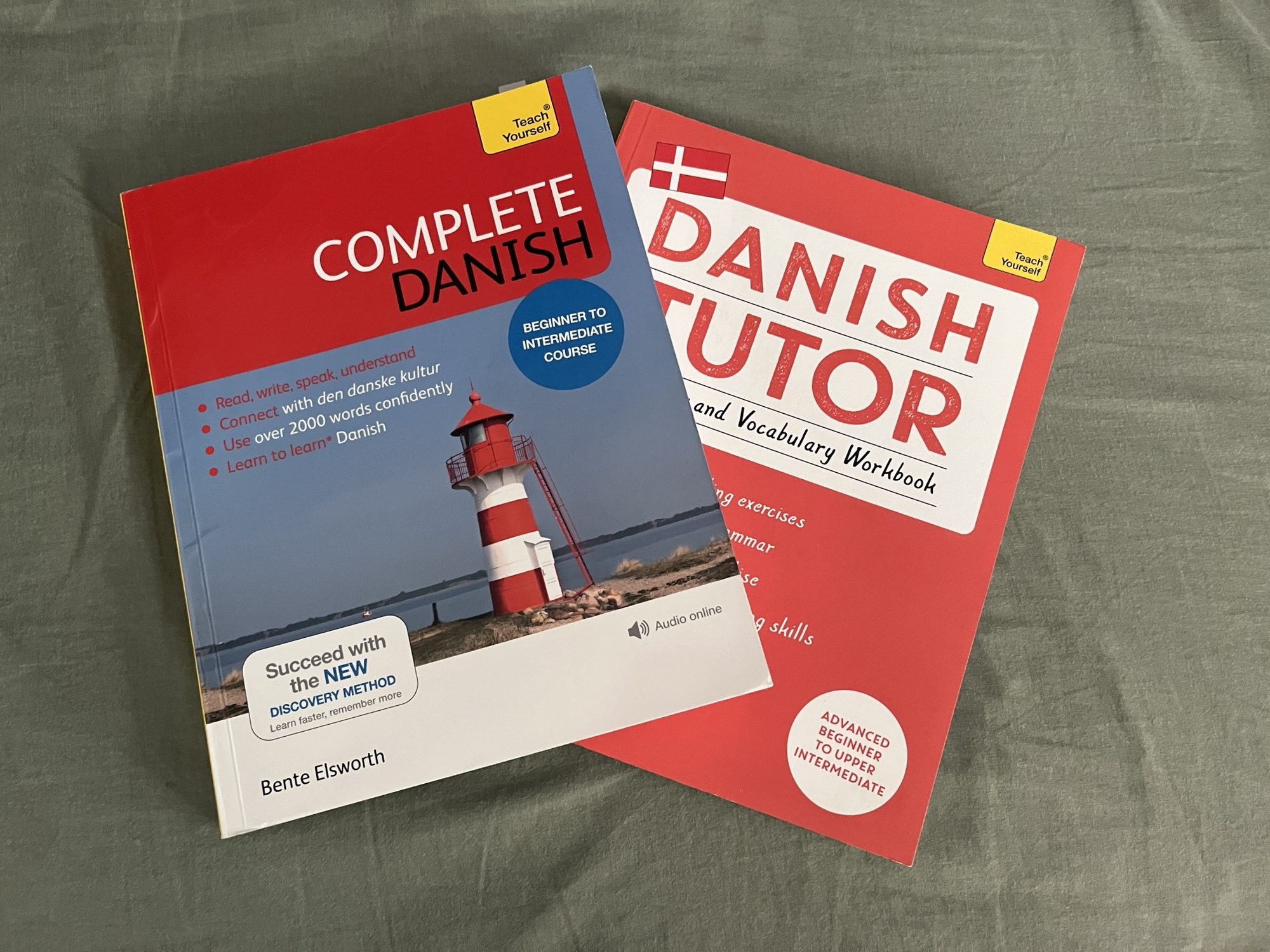
In previous blog posts, I’ve mentioned how I’m trying to learn Danish. Trying being the operative word. I’ve bought the grammar books. I have access to listening and reading materials. I can practice my speaking skills with my parents. Now its just a matter of putting everything into a routine that doesn’t take up too much time and I can stick to constantly.
In high school, my French classes were almost exclusively focussed on grammar. Any speech practice only guaranteed short term memorization. And as for vocabulary building?

Meanwhile, my knowledge of Danish was in the toilet.
After years of Duolingo (don’t get me started), one-off language classes, and sporadic vocabulary lessons over dinner with my grandparents during even more sporadic trips to Denmark,
I got fed up and wanted to figure out a plan that was going to work.
When I looked into other people’s schedules, most of the time, I found plans by polyglots learning multiple languages. I appreciate the hustle but…baby steps guys. Otherwise, I was faced with routines for learning one component. For example, spending 30 minutes a day listening to a podcast in your target language.
Great! Where’s the rest of ya?
I did find one blog post with a study plan that I liked. While still focussed on multiple languages, the breakdown combined input and output and studying grammar, which was what I was looking for. I also took what I learned from Gabriel Wyner and incorporated flashcards for vocabulary. For now, this created a schedule and routine that lets me consistently and steadily learn Danish without taking up all my free time.
My schedule to learn Danish
| Monday | Tuesday | Wednesday | Thursday | Friday | Saturday | Sunday |
|---|---|---|---|---|---|---|
| Study flashcards | Study flashcards | Study flashcards | Study flashcards | Study flashcards | Study flashcards | Study flashcards |
| Read in Danish | Read in Danish | |||||
| Study grammar workbook | Study grammar workbook | Study grammar workbook | ||||
| Watch/listen to Danish | Watch/listen to Danish | |||||
| Write in Danish | Write in Danish | Write in Danish | Write in Danish | |||
| Speak in Danish | Speak in Danish | Speak in Danish |
Schedule Breakdown
Learn Danish Grammar
Three times a week, I study Danish grammar and I spend 30-45 minutes studying at a time. I alternate between two grammar books: Complete Danish and Danish Tutor, from the Teach Yourself series. For this, I wrote a “schedule” that tells me which chapter of which book to study next based on the CEFR level(s).
After I have spent the allotted time actually studying the grammar, I go back over the content and copy new vocabulary and new grammar concepts into their own dedicated notebook. This helps me to:
- Retain the information covered by writing it out by hand
- Have a resource to create flashcards from
I try to make the flashcards in Anki on a separate day just for the sake of time management (see below). Of course, this varies from day-to-day.
Input: Flashcards
In the book Fluent Forever, which I reviewed in last week’s blog post, the author Gabriel Wyner discusses the importance of flashcards to encourage memorization using the Spaced Repetition System or SRS. Following his advice, I began building a flashcard deck using the flashcard software Anki.
All of my flashcards are kept in a single deck instead of separating the information into multiple decks (some prefer to separate words and sentences into two decks). The flashcards consist of single words, phrases, and sentences in Danish. The front side gives either the English translation or an image for concrete words or phrases and the back side gives the Danish form.

Input: Reading in Danish
Twice a week, I spend 15-30 minutes reading in Danish.
Currently, I’m reading Short Stories in Danish by Olly Richards. It is part of a series of books aimed towards language learners. The short stories in this book are aimed towards A2-level. They are broken down into small chapters with a vocabulary list and a multiple choice quiz at the end of each.

Another useful reading resource for learning Danish is DR Ligetil. The Danish Broadcasting Corporation (DR) created it. The website is full of articles written in a simplified Danish for “hesitant readers”.
Input: Listen to/Watch something in Danish
The second type of input I focus on is hearing Danish. I work on this by spending 15-30 minutes watching or listening to something in Danish. Like reading, I do this twice a week.
When I’m watching something, I don’t have captions on in any language. In Fluent Forever, Wyner explains that “[t]he problem with subtitles is that reading is easier than listening. We learn with our eyes more than our ears, and so when subtitles are present, we don’t improve at listening.”
Right now, I’m watching The History of Denmark (Historien om Danmark) on DR. It’s a mini-series telling the full history of Denmark beginning with the Stone Age. Lars Mikkelsen hosted the series.
Output: Writing in Danish
Four times a week, I spend 15 minutes writing in Danish. When I first began this routine, I wanted to write everyday, but that quickly fell apart. This is because I ran out of things to write about. Also, I didn’t have any time put aside to practice speaking Danish.
Breaking down this writing routine to four times a week means I can absorb the vocabulary I’m studying with my flashcards. Then I can incorporate it into my writing more easily.
Output: Speaking Danish
On the schedule, I spend three days a week speaking Danish. Truthfully, I’ve only just added this to the plan, so I haven’t actually done it yet. So far, I mostly speak Danish while studying my flashcards. Of course, this is important because I need to develop the muscle memory of saying these words and phrases. But I also need experience in actual conversation. Because I live with my parents, the best way I can do this is by talking to them in Danish.
References:
- #174 A Daily Language Learning Routine
- The CEFR Levels
- Complete Danish: Beginner to Intermediate Course
- Danish Tutor: Grammar and Vocabulary Workbook
- Short Stories in Danish for Beginners by Olly Richards
- Ligetil | DR
- Historien om Danmark (TV Mini-Series 2017) – IMDb
Leave a Reply