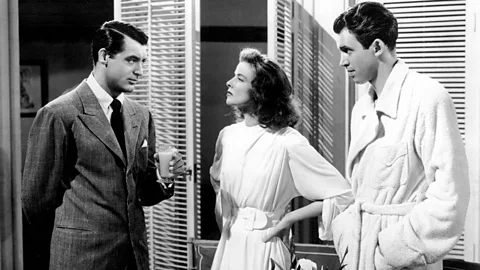

Classic Hollywood and old movies have always been a point of fascination for me. As a preteen, I had Turner Classic Movies playing on rotation, introducing me to the likes of Audrey Hepburn, Sydney Poitier, Gregory Peck, and so on. My fascination continued into adulthood as I listened to podcasts like You Must Remember This, which tells stories of the behind the scenes of famous classic films, their stars, and the culture of Hollywood throughout the 20th century.
One particular point of fascination about Classic Hollywood from a linguistic perspective is the concept of the Transatlantic accent – a manufactured accent put on by classic stars like Katharine Hepburn and Ginger Rogers. Its use has become synonymous with classic films of the 1930s and 40s.
Speaking in a Transatlantic accent
The Transatlantic Accent proposes five steps to learn how to speak in the dialect:
- Drop that R
- Open ‘ah’ Vowels
- Hard T instead of d
- “Happy” = “Happeh”
- Avoid Americanism and Britishisms
1. Drop that R
Transatlantic is a non-rhotic accent, meaning the R’s that appear at the ends of some words are dropped entirely. For example, the R-sound in car is dropped so that the speaker pronounces it as cah. Or winner is pronounced winnah.
2. Open ‘ah’ Vowels
‘A’ vowel sounds in the Transatlantic accent are low and open. They get drawn out so that words like dance sounds like dahnce or basket sounds like bahsket.
3. Enunciate the T
For a Canadian like myself, the ‘t’ sound in words like butter or water becomes “blunted” to sound like a d-like sound called a flap or tap (budder, wad-er). The Transatlantic accent, however, requires those T’s to be clearly enunciated just as you see it in the spelling.
4. Long ‘ee’ Vowels
Similar to the long ‘ah’ vowel sounds mentioned in #2, the ‘ee’ sounds at the end of words like happy and pretty should be relaxed and lengthened to sound like happ-eh and prett-eh. If you would like a more contemporary example of what this sounds like, think of when Moira Rose would say “bebe” for baby in Schitt’s Creek.
5. Avoid distinctly American or British idioms
The accent is meant to be a mix of American and British English. Therefore, avoid any idioms more closely associated with one region over the other. This is to maintain the ambiguity of the accent so listeners cannot tell whether you are American or British. So avoid the phrase “ten a penny” if you don’t want to be identified as British and “sleep in the streets” for the same with American.
Stephanie Wallace, who created the website, offers that if you must use an idiom in your speech, stick to an American English because the Transatlantic accent first gained popularity in the United States.
The origins of the Transatlantic accent
Australian phonetician William Tilly developed the Transatlantic accent in the early 1900s. Described as a cross between the British Received Pronunciation accent and the Standard American English accent, it first became popularized by its use in American finishing schools to distinguish the upper class. Anna Keizer writes that the accent “became a way of claiming one’s space in the upper echelons of society”.
What’s in a name?
While the most common terms for this are Transatlantic accent (which I use throughout this post) and Mid-Atlantic accent – referring to its being a mix of British and American English dialects – other names referring to it include World English (the name given to it by Tilly), Good American Speech (from renowned speech coach Margaret Prendergast McLean), and Eastern Standard (by McLean’s contemporary Edith Skinner).
The Hollywood legacy of the Transatlantic accent
Hollywood’s adoption of the Transatlantic accent first began with its inclusion in oratory classes and theatre starting in the 1920s and continuing into the 40s. This expanded into film. The Studio System that controlled Hollywood in the 1930s and 40s encouraged the accent’s use by actors “as an affirmation of their elitism”.
The accent fell out of favour following World War II. Schools stopped encouraging it and many actors abandoned it. Criticisms of the ‘artificiality’ of the accent contributed to its drop in popularity in Hollywood specifically as Method acting and other modern acting techniques entered the mainstream. Plus, the fall of the Studio System meant film studios had less control over their actors and that included whatever elocution method they ascribed to.
References:
- The Transatlantic Accent | A History and How-To Guide to Sounding “Old-Timey”
- The Transatlantic Accent: What Is It and How Do You Talk In It?
- How to Do a Transatlantic Accent Like a Classic Movie Star
- “Standard Speech: The Ongoing Debate” by Dudley Knight
- World English? How an Australian Invented “Good American Speech”
- What is the Studio System — Hollywood’s Studio Era Explained
- MOIRA ROSE SAYING BÉBÉ FOR 60 SECONDS
Leave a Reply