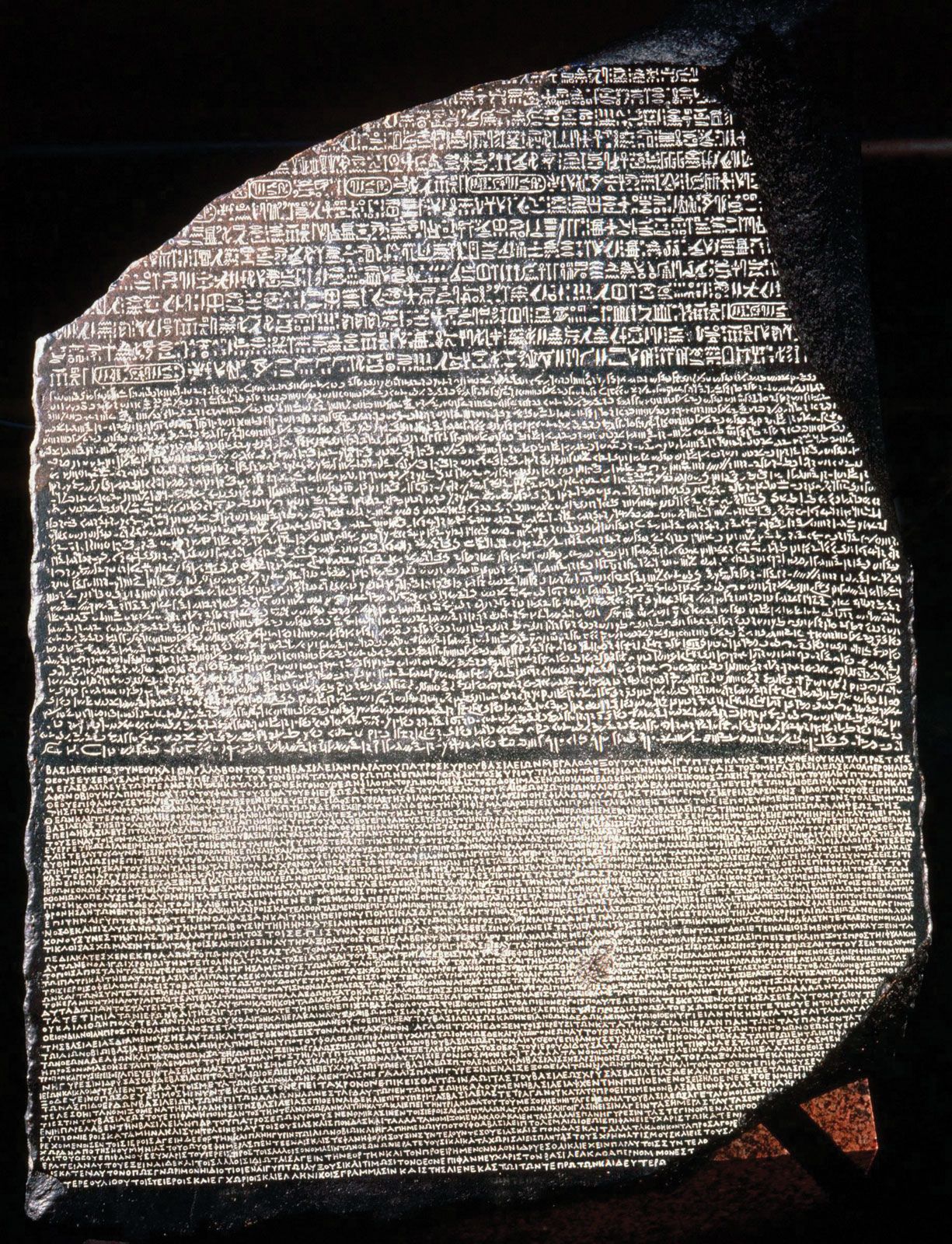
You’ve likely heard of Rosetta Stone, the popular language learning software. You’re probably even aware of its namesake, the Rosetta Stone. And how it is the reason we can read Egyptian hieroglyphs. But how much of the story do you know?
Here’s the history of the Rosetta Stone: why it exists in the first place, how soldiers found it, and how linguistics deciphered it.
What is the Rosetta Stone?
The Rosetta Stone is an ancient Egypstian stone featuring text repeated in two languages: Ancient Greek and Egyptian (written both in Egyptian hieroglyphs and Demotic). The stone was erected during the reign of Ptolemy V Epiphanes (205-180 BCE).
The stone is what remains of a stela, a large granite slab housed in a temple in Ancient Egypt. The remaining stone measures 3 feet 9 inches (114 cm) long and 2 feet 4.5 inches (72 cm) wide. Portions of the whole stone (or stela) were broken off prior to its recovery and have never been found. The image below shows a possible rendering of the original stela.

French soldiers found the stone in July 1799, near the town Rashin (called Rosetta by the French, hence why we call it the Rosetta Stone), northeast of Alexandria.
How did scholars desipher the Rosetta Stone?
English physicist Thomas Young led the first attempts to decipher the hieroglyphs on the Rosetta Stone. He successfully identified the glyph for Ptolemy V: a cartouche (a series of glyphs encased in an oval, pictured below) which repeats six times in the text. Young also identified the reading direction of hieroglyphs based on the directions animals glyphs were faced.

Meanwhile, Frenchman Jean-Francois Champollion identified how the glyphs operated. Some glyphs represent individual sounds, individual syllables, and/or ideas or objects. Also, Champollion concluded that Ancient Greek was the language of the original text, with the two Egyptian scripts being translations.
The history of Rosetta Stone-ownership
In 1801, France surrendered Egypt to Great Britain. The Rosetta Stone has been a British property ever since. Today, it is displayed at the British Museum.
However, there have been calls to return the Stone to Egypt. Monica Hanna, dean at the Arab Academy for Science, Technology & Maritime Transport, and Zahi Hawass, former Egyptian Minister of Tourism and Antiquities, each have organized petitions demanding so. Both Hanna and Hawass claim the British took the Stone illegally as a ‘spoil of war’.
The British Museum has refused to return the Stone. They claim 1) an Ottoman admiral signed the original 1801 treaty as an Egyptian representative (at the time, Egypt was technically under Ottoman rule), and 2) Egypt owns several copies of the Stone’s text, so there is no need to own the original.
References:
- Rosetta Stone | Definition, Discovery, History, Languages, & Facts | Britannica
- Cartouche | Egyptian hieroglyphs, Pharaohs, & Royalty | Britannica
- The Rosetta Stone: everything you need to know | British Museum
- Egyptians call on British Museum to return the Rosetta Stone | PBS News

Leave a Reply