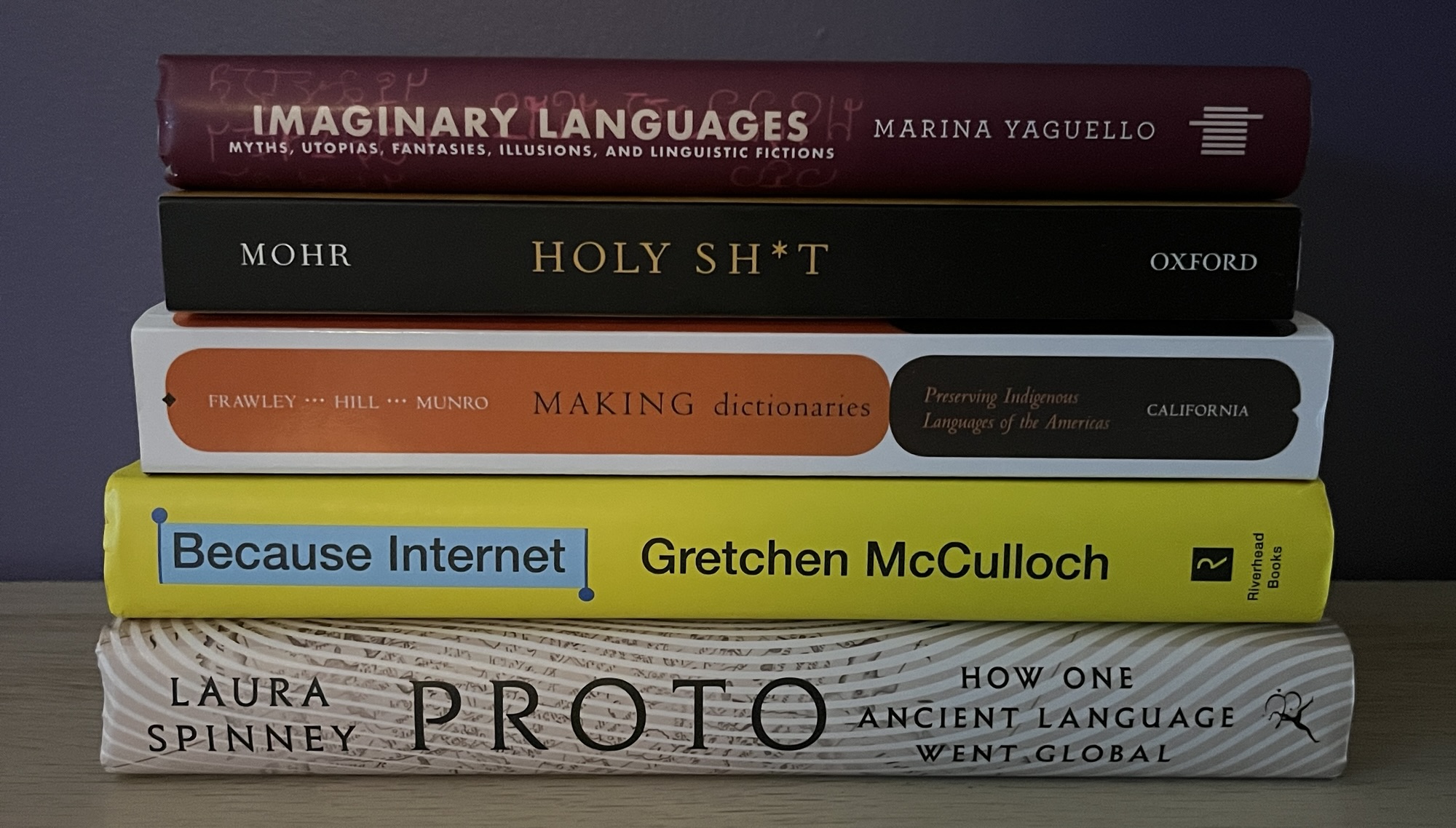
Now that 2025 is coming to a close and it’s time to get ready for 2026, I’m starting to think about my goals for the next year. One thing I definitely want to do is read more books about languages and linguistics. With that, here is my 2026 TBR (to-be read) list.
- Babel (R. F. Kuang)
- Because Internet (Gretchen McCulloch)
- Proto: How One Ancient Language Went Global (Laura Spinney)
- Cultish (Amanda Montell)
- Mother Tongue: The Surprising History of Women’s Words (Jenni Nuttall)
- Stories of Your Life and Others (Ted Chiang)
- Making Dictionaries: Preserving Indigenous Languages of the Americas (Ed. William Frawley)
- Imaginary Languages: Myths, Utopias, Fantasies, Illusions, and Linguistic Fictions (Marina Yaguello)
- Holy Sh*t: A Brief History of Swearing (Melissa Mohr)
- Language City: The Fight to Preserve Endangered Mother Tongues in New York (Ross Perlin)
- A Stitch in Time: The Year a Brain Injury Changed My Language and LifeA Stitch in Time: The Year a Brain Injury Changed My Language and Life (Lauren Marks)
- Wordslut (Amanda Montell)
January

Babel, Or the Necessity of Violence: An Arcane History of the Oxford Translators’ Revolution by R. F. Kuang
A novel about the negative impacts of colonialism set in a fantastical version of 1830s Oxford. I’m already a huge fan of R. F. Kuang so can’t wait to start the year off by biting into this!
February

Because Internet: Understanding the New Rules of Language by Gretchen McCulloch
A deep dive into the unique way the Internet has changed the way people use language. (Also, Gretchen McCulloch once complimented my Wug pillow on Facebook so we’re basically best friends.)
March

Proto: How One Ancient Language Went Global by Laura Spinney
A new release. This book goes through the history of Proto-Indo-European, the proposed ancestor for all of the languages in the Indo-European family.
April

Cultish: The Language of Fanatacism by Amanda Montell
A look into how cults (and “cults”) use language to manipulate and control their followers.
As someone fascinated by linguistics and cults, I hope this perfectly satisfies my little nerd brain.
May

Mother Tongue: The Surprising History of Women’s Words by Jenni Nuttall
An investigation of how women have been referred to historically.
June

Stories of Your Life and Others by Ted Chiang
A collection of sci-fi and fantasy short stories and novellas. The most famous story in the collection, “Story of Your Life”, was adapted into the 2016 movie Arrival.
July

Making Dictionaries: Preserving Indigenous Languages of the Americas edited by William Frawley
A collection of academic articles discussing different methods of documenting endangered Indigenous languages. My thesis supervisor introduced me to the book during my Master’s as a potential source of inspiration and have wanted to return to it since to give it my full attention.
August

Imaginary Languages: Myths, Utopias, Fantasies, Illusions, and Linguistic Fictions by Marina Yaguello
This book explores the concept of imaginary languages. Yaguello goes beyond your typical conlangs like Klingon from Star Trek or Elvish from The Lord of the Rings. She also discusses linguistic universality and the motives and practices behind inventing imaginary languages.
September

Holy Sh*t: A Brief History of Swearing by Melissa Mohr
Just like the title says. In this book, Mohr goes into how and why people swear and how the linguistic divide between civility and vulgarity was formed.
October

Language City: The Fight to Preserve Endangered Mother Tongues in New York by Ross Perlin
Before I first picked up a copy of this book, I had no idea New York City was the most linguistically diverse city in the world. In the book, Ross Perlin shares the story of six people who speak endnagered languages and how they are working to preserve them.
November

A Stitch in Time: The Year a Brain Injury Changed My Language and Life by Lauren Marks
After suffering a brain aneurism at 27, Lauren Marks couldn’t speak, read, or write. In other words, she couldn’t communicate at all. In this book, she chronicles her experience re-acquainting herself with language.
Also, I recommend Marks’ interview on the Allusionist to hear more of her story.
December

Wordslut: A Feminist Guide to Taking Back the English Language by Amanda Montell
The predecessor to Cultish (see above), Wordslut is about how the English language has been used as a weapon against women.
Leave a Reply