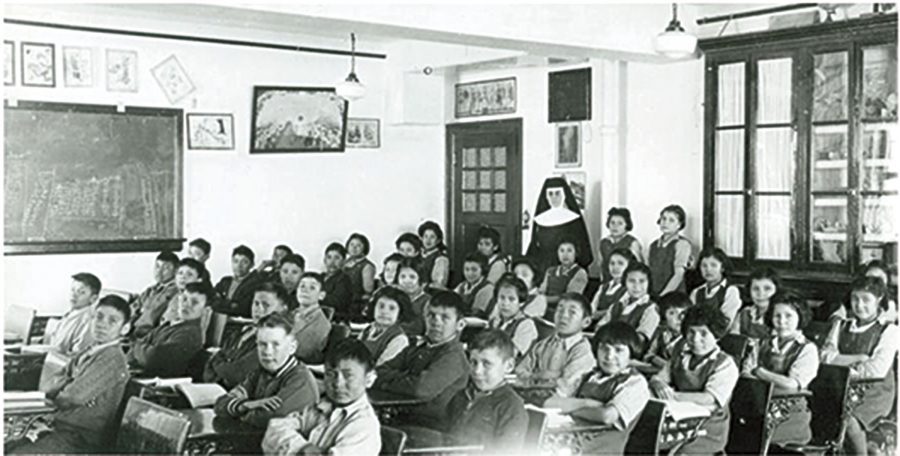
September 30th is the National Day for Truth and Reconciliation in Canada. Also called Orange Shirt Day, it was first established by the non-profit organization the Orange Shirt Society in 2013. In 2021, it became a national holiday. The purpose of the holiday is to raise awareness about the impact and legacy of residential schools in Canada.
It’s a day to honour the resilience, dignity and strength of survivors and intergenerational survivors and remember the children who never came home. (Saint Marie among the Hurons)
Establishment of the federal holiday enacts Call to Action #80 of the Truth and Reconciliation Commission of Canada, which states:
We call upon the federal government, in collaboration with Aboriginal peoples, to establish, as a statutory holiday, a National Day for Truth and Reconciliation to honour Survivors, their families, and communities, and ensure that public commemoration of the history and legacy of residential schools remains a vital component of the reconciliation process.
The Residential School System
The federal residential school system first came into effect in 1883. However, church-run schools designed specifically for the conversion of Indigenous children trace back to the 1600s. They meant to serve a solution to the “Indian question”: how to deal with the ‘threat’ and barrier Indigenous peoples posed to the construction and expansion of the newly-formed Canada.
Residential schools housed Indigenous children and forced them to adopt “European traditions, languages, and lifestyles”. The schools were overcrowded and children were underfed, punished for speaking their native languages, and victims of physical and sexual abuse.
According to the TRC’s Final Report, 2,040 named students died at residential schools. In addition, when combined with unnamed students, the death total is 3,201. This covers the period of 1867 to 2000 when residential schools were operating. Of course, we will never know exactly how many children died, though we can expect the number to be much higher.
Contributions to Language Endangerment and Extinction
The shame the staff in the schools placed on the children about their language, culture, and traditions travelled home with them. It was passed down generations. Parents did not teach children their native language or customs. This is what the TRC means when the describe what took place at residential schools as cultural genocide.
Today, of the approximately 70 Indigenous languages still spoken in what is now considered Canada, 40 languages have 500 speakers or less. While residential schools are not the only reason for this decline in the number of speakers, it has contributed to the decline in language transmission.
Revitalization Efforts
In 2019, the Canadian federal government passed the Indigenous Languages Act. The Assembly of First Nations, Métis Nation, and the Department of Canadian Heritage collaborated over its development. Also, it addresses Calls to Action #13, #14, and #15 of the Truth and Reconciliation Commission as well as the United Nations Declaration on the Rights of Indigenous Peoples. The purpose of the Act is to support Indigenous peoples’ efforts in documenting, promoting, and revitalizing their language.
Language revitalization efforts have been carried out for years. Multiple universities and colleges have programs dedicated to language revitalization. For instance, the University of Victoria has their Indigenous language revitalization program. The program offers both Bachelor’s and Master’s degrees in the subject. Additionally, the University’s Continuing Studies division offers a Certificate in Indigenous Language Revitalization.
Outside of academia, many Indigenous communities have set up their own programs to revive their language. For example, languages nests: an immersion program where a child (between birth and five years old) is paired with an Elder fluent in their native language where the child is exposed to the language and introduced to the culture and traditions of their Nation or community.
Resources:
I cannot appropriately summarize the vastness of efforts being made towards Truth and Reconciliation and language revitalization in Canada in this short blog post. In accordance with the National Day for Truth and Reconciliation, I invite you to spend time learning about Canada’s Indigenous peoples, their languages, and the efforts they are making to revitalize them. Please also take the time to learn more of the history of residential schools in Canada. If you wish to donate to any organizations, I have also included links for those.
On Canada’s Indigenous Languages:
- Indigenous Languages in Canada | The Canadian Encyclopedia
- Why Is It Important to Protect and Revitalize Indigenous Languages | Indigenous Corporate Training Inc.
On Language Revitalization:
- Language Nest Curriculum | Chippewas of Nawash Unceded First Nation
- Canadian Indigenous Languages and Literacy Development Institute | University of Alberta
On Truth and Reconciliation:
On the History of Residential Schools:
To make a donation:
- Indian Residential Schools Survivors Society
- National Center for Truth and Reconciliation
- Gord Downie and Chanie Wenjack Fund
References:
- National Day for Truth and Reconciliation | Government of Canada
- National Day for Truth and Reconciliation | Saint Marie among the Hurons
- What is the National Day for Truth and Reconciliation? | The Indigenous Foundation by Shreya Shah
- History of Residential Schools | Indigenous Peoples Atlas of Canada
- Residential School History | NCTR.ca
- Canada’s Residential Schools: Missing Children and Unmarked Burials | NCTR.ca
- Indigenous Language Revitalization | The Canadian Encyclopedia
- Language Nest Handbook for B. C. First Nations Communities | First Peoples’ Cultural Council
Leave a Reply